A bolt is the cheapest part on the drawing. It's also the one most likely to end your relationship with a client.
Nobody escalates a fastener failure gently. It shows up as a stalled assembly line, a warranty claim, a recall notice, or a client's engineer asking why a $0.40 part took down a $40,000 machine. By the time that conversation happens, the decision that caused it was made months earlier when someone approved a supplier without asking the right questions.
Most of that risk isn't visible in the part. It's visible in the process behind it, and in paperwork that's easy to skip past when a sample looks fine and the price is right.
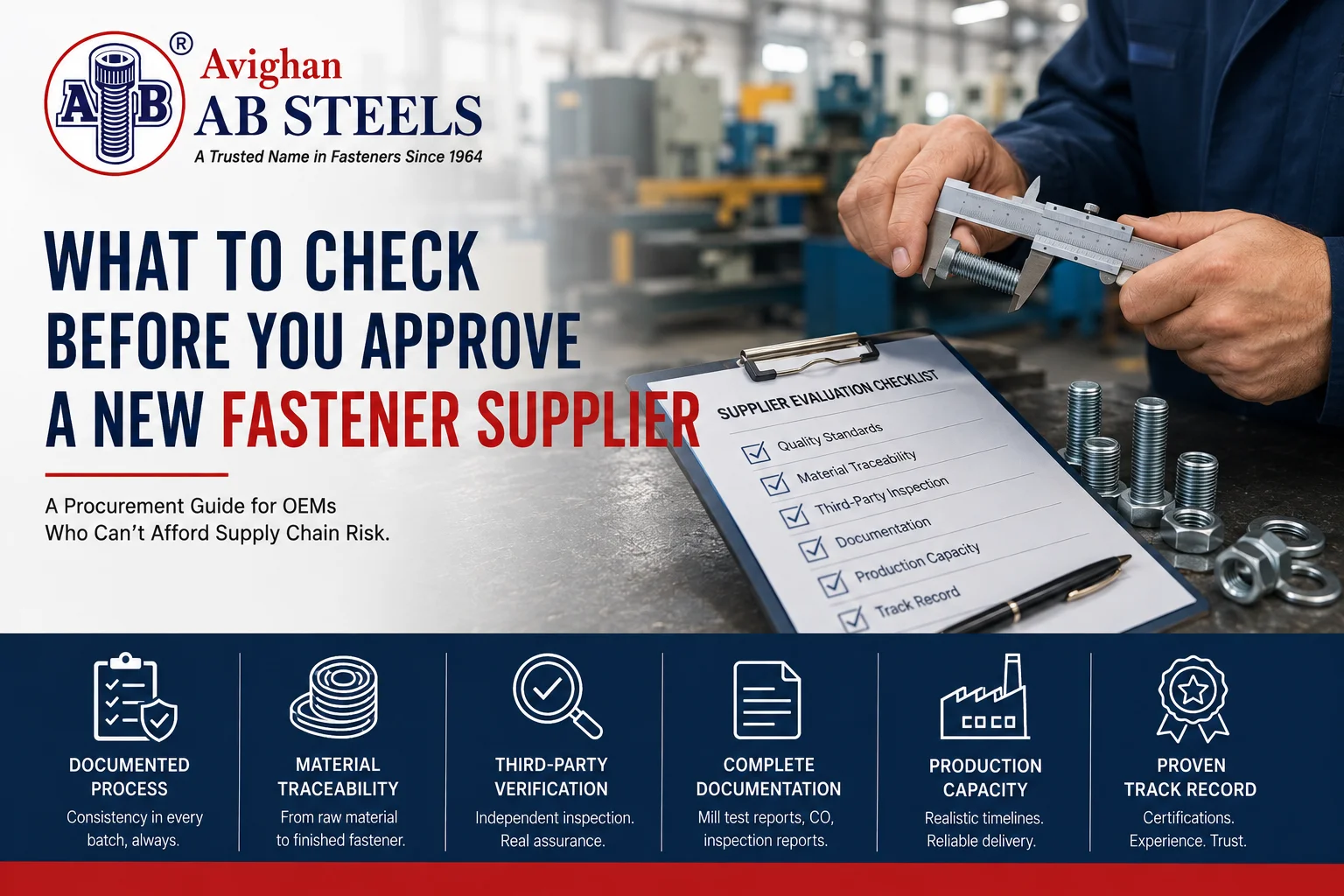
Here's what should actually be on the checklist and why each item exists.
1. A documented process, not just a good sample
Any supplier can send you one excellent part. That's not what you're buying. Ask what standard the fastener is manufactured to — DIN, ISO, IS, BSW, BSF — and then ask a harder question: how is that standard held constant across every batch, not just the one you tested?
A supplier who can talk fluently about their own production process tolerances, inspection stages, rejection criteria — is telling you something different from a supplier who can only produce a spec sheet. The spec sheet describes the part you saw. The process determines every part you haven't.
2. Material traceability, from coil to crate
If a fastener fails in the field six months from now, can the supplier tell you which raw material batch it came from? Which heat number? Which mill supplied the steel?
This sounds like paperwork until it isn't. Without traceability, a single failure can't be contained you don't know if it's one bad part or one bad batch of hundreds already installed elsewhere. With it, a problem gets isolated in days instead of becoming a recall.
3. Third-party verification not self-certified quality
ISO 9001:2015 tells you a supplier has a documented quality management system on paper. It doesn't tell you whether that system holds up on a rushed production day, under a tight deadline, with a machine running slightly out of calibration.
Ask directly: will they allow third-party pre-shipment inspection SGS, Bureau Veritas, TÜV, or an agency you nominate yourself? A supplier who's confident in their own process has no reason to make this difficult. A supplier who hesitates, delays, or tries to limit which agency you can use is telling you something too.
4. What actually ships with the order
A commercial invoice and packing list are table stakes every supplier provides those. The documents that actually protect you are the ones suppliers sometimes treat as optional:
- Certificate of Origin required at customs, and increasingly checked for compliance reasons
- Mill test certificates your only proof of the material's actual composition and properties
- Inspection reports your evidence trail if a claim ever needs to be made
If these arrive as an afterthought, assembled only because you asked, that usually means they weren't built into the supplier's standard process which raises the question of what else isn't standard.
5. Capacity that matches the promise
A supplier who says yes to every order size, every timeline, and every custom spec without ever pushing back is either extremely capable or not being straight with you. Ask about actual stock depth how many variants do they hold ready versus manufacture to order? What's the real lead time when a size isn't in stock? A supplier who gives you a specific, sometimes inconvenient answer is more trustworthy than one who says everything is always available.
6. A track record that can be independently checked
Certifications matter, but they matter more in combination with time. ISO 9001, ZED Bronze, SMERA ratings each requires an external body to verify a company's process rather than take its word for it. Layer that against an actual operating history how long has this supplier been manufacturing, not just exporting or trading and you get something much harder to fake than a well-designed catalogue or a professional-looking website.
Longevity alone isn't proof of quality. But a company that's been supplying demanding domestic industries for decades has already been tested by clients with less patience and less formal process than an international audit and that's its own kind of evidence.
The real question underneath all of this
No supplier is perfect, and no checklist eliminates risk entirely. What separates a good supplier relationship from a costly one isn't the absence of problems — it's what happens when a problem shows up.
Can you trace it? Can you isolate it? Is there a paper trail, or just a phone call that starts with "let us check and get back to you"?
That's the difference between a supplier you audit once, thoroughly, and a supplier you end up auditing forever.